If you are buying a used mobile C-arm for theatre, two names come up again and again: the Philips BV Pulsera and the GE OEC 9900 Elite. Both are image-intensifier C-arms from the generation before flat-panel detectors, both are widely installed around the world, and both remain popular on the used market because they are reliable and much cheaper than new systems.
This guide compares them side by side: image quality, power, heat capacity, vascular features, size and price. It is written for hospital buyers, theatre managers and biomedical engineers deciding which system suits their work and budget.
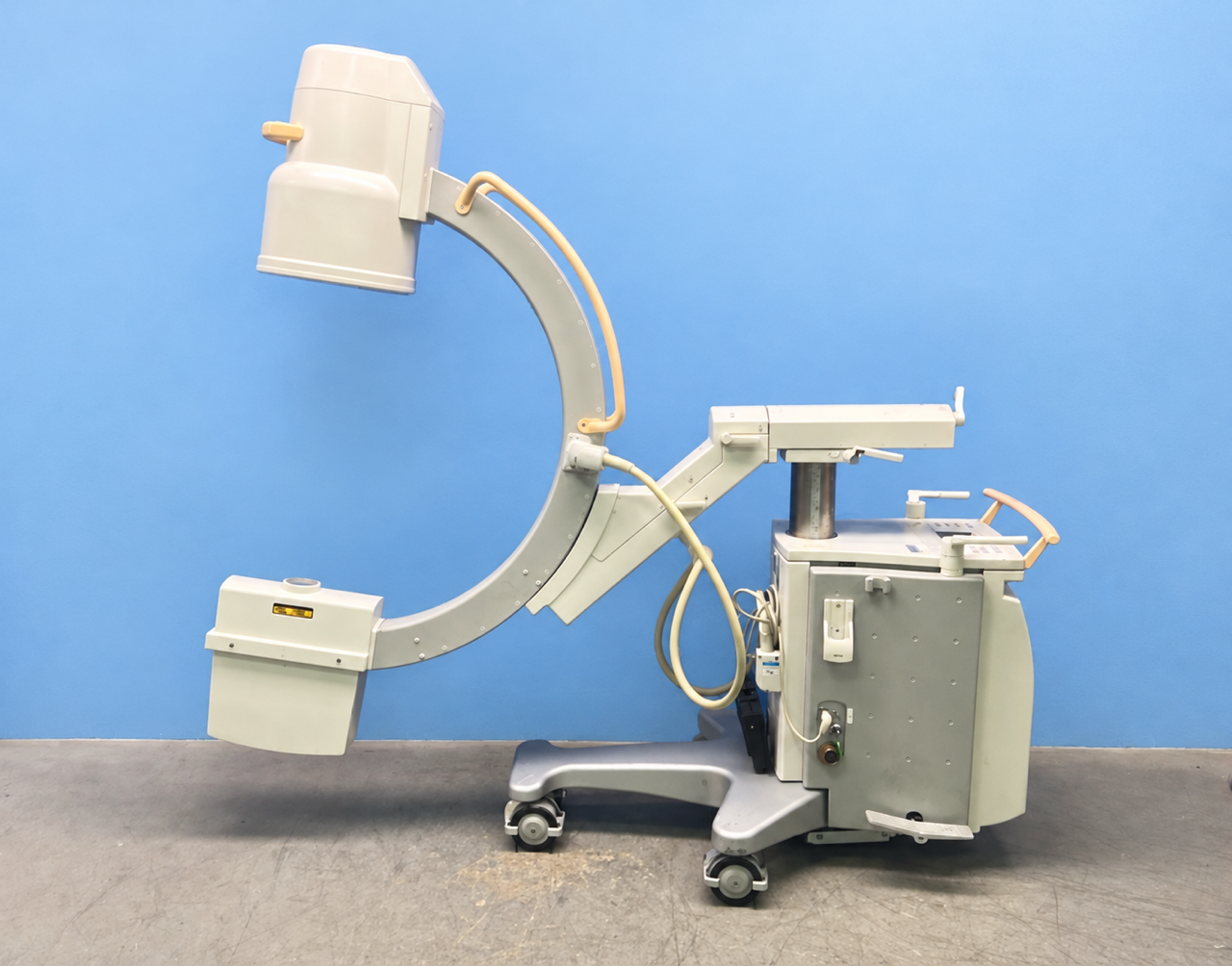
Quick answer
- Choose the Philips BV Pulsera if you want a dependable, lower-cost C-arm for orthopaedics, trauma, pain management, urology and general surgery, and a straightforward system your team can learn quickly.
- Choose the GE OEC 9900 Elite if you need more generator power for larger patients, longer high-output cases, or dedicated vascular and cardiac software, and your budget allows a higher price.
- For most general theatre work, both produce good diagnostic images. The bigger differences are generator power, software packages, service support in your country and price.
What is the Philips BV Pulsera?
The BV Pulsera is a mobile C-arm made by Philips in the Netherlands. It sits at the top of Philips' image-intensifier BV range, above the BV Libra and BV Endura, and was later succeeded by the flat-panel Veradius and Zenition families. It pairs a C-arm stand with a separate mobile viewing station carrying two monitors.
Key published specifications include:
- Image intensifier: 9 inch tri-mode (9/7/5 in) as standard, or 12 inch tri-mode (12/9/7 in) as an option
- Generator: 7.5 kW high-frequency (80 kHz), up to 120 kV
- X-ray tube: rotating anode, 0.3 mm and 0.6 mm focal spots, 300,000 HU anode heat capacity
- Pulsed fluoroscopy: pulsed modes for lower dose, including half-dose and quarter-dose fluoroscopy settings
- Vascular functions: subtraction and roadmapping on suitably configured systems (our unit's footswitch is labelled Fluoro, Sub, Trace and Roadmap)
- Weight: around 315 kg for the C-arm stand
What is the GE OEC 9900 Elite?
The OEC 9900 Elite is GE HealthCare's mobile C-arm that replaced the long-running OEC 9800. It was sold from around 2010 until it was succeeded by the OEC One and the flat-panel OEC Elite CFD. It is one of the most common C-arms in North America and is widely traded internationally.
Key published specifications include:
- Image intensifier: 9 inch tri-mode (9/6/4.5 in) or 12 inch tri-mode (12/9/6 in)
- Generator: 15 kW high-frequency, up to 120 kV, with a battery-buffered design that runs from a standard wall socket
- X-ray tube: rotating anode, 0.3 mm and 0.6 mm focal spots, 300,000 HU anode heat capacity
- Software packages: GSP (general surgery), ESP, Vascular, NeuroVascular and Cardiac, plus a "Super C" deep-arc version for extra clearance
- Workstation: dual flat-panel monitors on an articulating arm with a touchscreen control
Side-by-side comparison
Image quality
Both use image intensifiers with a CCD camera and are available in 9 inch and 12 inch versions. GE quotes higher central resolution on the 9900 Elite, particularly in the smaller magnification modes, which helps with fine detail in extremities and small anatomy. In everyday orthopaedic and general surgery work, both give clear, usable images when the intensifier and camera are in good condition. On any used C-arm, the age and condition of the image intensifier matter more than the brand.
Generator power
This is the biggest technical difference. The 9900 Elite has a 15 kW generator, while the BV Pulsera has 7.5 kW. More power helps with larger patients, lateral spine and hip views, and high-level fluoroscopy. For hands, feet, limbs, pain injections, urology and most trauma work, the Pulsera's power is usually enough.
Heat capacity and long cases
Both have a rotating-anode tube with the same 300,000 HU anode heat capacity, which is good for a mobile C-arm. Both handle long procedures well. GE quotes a slightly faster anode cooling rate on the 9900 Elite.
Vascular and cardiac work
Both can perform digital subtraction and roadmapping when configured with the right options. GE offers clearly separated software packages (Vascular, NeuroVascular, Cardiac), and the 12 inch Vascular or Cardiac 9900 Elite is a common choice for hybrid and vascular theatres. If vascular work is your main use, check exactly which software is enabled on the unit you are buying, for either brand.
Size, handling and monitors
Both are full-size mobile C-arms with a separate monitor cart. The BV Pulsera is known for rear-wheel steering and an easy-to-position stand. The 9900 Elite's monitors sit on an articulating arm with a touchscreen, which many users find convenient. Check door widths and lift access before delivery, as both are heavy.
Service and parts
Both have good third-party parts and engineering support. GE OEC systems are especially common in the US, so parts are plentiful there. Philips BV systems are very common in Europe, the Middle East and Africa. The best choice is often the brand your local engineers already know.
Price: what to expect
Prices vary widely with year, intensifier size, software options, condition and whether a warranty is included.
- US dealer prices for a refurbished OEC 9900 with a one-year warranty have been quoted at roughly $82,000 for a 9 inch system, up to about $110,000 for a 12 inch vascular system (Block Imaging, 2024).
- Used systems sold without a full refurbishment or long warranty, especially on the international market, usually cost much less.
- Our 2013 Philips BV Pulsera is priced at £10,000, with the dual-monitor viewing station, footswitch and hand switch.
Remember to budget for delivery, installation, applications training, radiation protection checks and lead aprons. You can estimate shipping with our free shipping quote form.
Which one should you buy?
- Orthopaedics and trauma (limbs, hips, nailing): both work well. The 9900 Elite's extra power helps with larger patients and lateral hip views. The BV Pulsera is a strong, lower-cost option for most trauma lists.
- Pain management and spinal injections: both are suitable. Pulsed low-dose modes on either system help reduce dose.
- Urology and general surgery: either system. Choose on condition, price and service support.
- Vascular, EVAR and cardiac: look for a 12 inch system with vascular software. The 9900 Elite Vascular or Cardiac is a popular choice, and a vascular-configured BV Pulsera is a budget alternative.
- Tight budget or first C-arm for a new theatre: the BV Pulsera usually offers the best value.
Checklist before buying any used C-arm
- Ask for the year of manufacture, intensifier size and software options in writing.
- Ask for recent fluoroscopy images and a video of the system running, including C-arm movements and all monitors.
- Check that the image intensifier shows no burn-in, blemishes or uneven brightness.
- Confirm tube condition, the error log and when the system was last serviced.
- Make sure the footswitch, hand switch, collimators and laser aimer (if fitted) work.
- Check your local radiation regulations, registration requirements and mains supply.
- Agree who installs it, who trains your staff and what warranty is included.
Our experience supplying C-arms
Rising Medical Technologies supplies used and refurbished imaging equipment from the UK to hospitals and clinics worldwide. We have delivered and installed imaging systems across East, West and Central Africa, and we understand the practical issues buyers face there: power stability, room preparation, shipping and access to service. We can test a C-arm before shipping, send you videos and images, crate it for export and arrange installation and training.
Frequently asked questions
Is the Philips BV Pulsera still a good C-arm?
Yes. It is a proven image-intensifier C-arm with a rotating-anode tube and pulsed fluoroscopy. It remains a good choice for orthopaedics, trauma, pain management, urology and general surgery, especially where budget matters.
What is the difference between the BV Pulsera and the OEC 9900 Elite?
The main differences are generator power (7.5 kW on the Pulsera, 15 kW on the 9900 Elite), software packages, and price. Both have 300,000 HU anode heat capacity and are available with 9 inch or 12 inch image intensifiers.
Should I choose a 9 inch or 12 inch image intensifier?
A 9 inch intensifier suits most orthopaedic, trauma, pain and urology work and is lighter and cheaper. A 12 inch intensifier gives a larger field of view, useful for vascular work, abdominal imaging and larger anatomy.
How much does a used C-arm cost?
It depends on model, year, intensifier size, software and warranty. Fully refurbished US units with warranty can cost $80,000 or more, while used systems on the international market cost much less. Contact us for a quote on current stock.
Can you ship a C-arm to Africa or the Middle East?
Yes. We crate C-arms for export and ship worldwide by air or sea, and we can arrange installation, applications training and service support.
Looking for a C-arm? See our Philips BV Pulsera (2013), contact us on WhatsApp at +44 7438 375527, or use our Find equipment for me form and we will source the right system for you.
